Carbon Reduction Plan
Carbon Reduction Plan
Commitment to achieving Net Zero
Anderson Law LLP is committed to achieving Net Zero emissions by 2050.
Baseline Emissions Footprint
| Baseline Year: 1 April 2025 to 1 April 2026 | |
| Additional Details relating to the Baseline Emissions Calculations | |
| This is our first year of reporting our baseline emissions and forms the foundation for future measurement and reduction activities. Emissions have been calculated using UK Government GHG emissions‑conversion factors. Relevant Scope 3 categories reported include: business travel, employee commuting, waste generated in operations and purchased goods and services. | |
| Baseline year emissions: | |
| EMISSIONS | TOTAL (tCO2e) |
| Scope 1 | 3.1 |
| Scope 2 | 42.2 |
| Scope 3 | 81.1 |
| Total Emissions | 126.4 |
Current Emissions Reporting
Our current emissions reporting reflects our baseline year, which will be used as the reference point for measuring future reductions.
Emissions reduction targets
In order to continue our progress to achieving Net Zero, we have adopted the following carbon reduction targets.
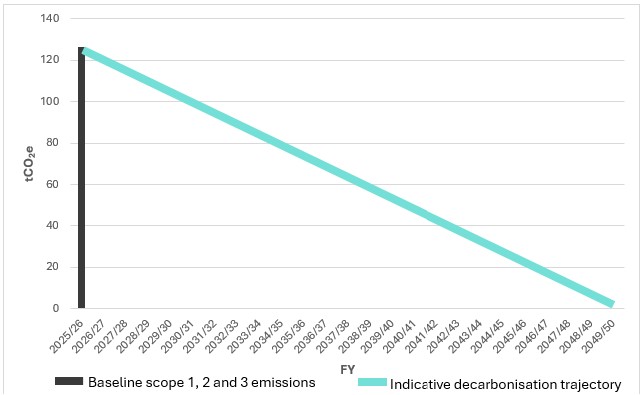
We project that carbon emissions will decrease over the next five years to 101 tCO2e by 2031. This is a reduction of 20%.
Progress against these targets can be seen in the graph below:
Carbon Reduction Projects
Since 2018 we have operated from Howbery Park, where environmental performance is embedded into the estate’s design and operations. The site benefits from mature parkland supporting biodiversity, a well‑established recycling infrastructure and significant on‑site renewable‑energy generation.
In 2025, solar generation across Howbery Park accounted for 29.37% of total electricity usage and 151,502 kWh of the park’s solar generated electricity was exported to the National Grid. This level of renewable generation supports our aim to operate with lower‑carbon energy and aligns with our longer‑term environmental commitments.
Alongside the environmental advantages of our location, we implement a range of in‑house initiatives to reduce our own operational emissions.
Key actions include:
- Reducing paper use and moving toward a paperless practice
We continue to reduce reliance on physical documentation by expanding digital document management, electronic signatures and online legal workflows. - Prioritising remote meetings
The majority of client and internal meetings are conducted online, helping us reduce unnecessary business travel without compromising service quality. - Encouraging sustainable travel
Where in‑person attendance is required, we prioritise the use of public transport wherever practicable and cost‑effective for clients. - Maintaining strong recycling practices
We operate clear waste‑separation processes for confidential and non‑confidential paper, as well as other recyclable materials, to maximise the amount of waste diverted from landfill. - Minimising single‑use materials
We continue to evaluate and reduce single‑use products within the office environment as part of our ongoing environmental improvement efforts.
These initiatives form the core of our direct contribution to reducing emissions and support our long‑term progression towards net zero.
Future carbon reduction initiatives
Energy and Renewable Use
- Increase use of renewable energy at Howbery Park
Work with the estate to explore ways of increasing the proportion of on‑site renewable electricity (already 29.37% solar in 2025) and support any estate‑wide improvements to low‑carbon energy infrastructure.
Travel and Accommodation
- Promote electric vehicles
Encourage staff to consider EV options by sharing guidance on charging availability and any relevant incentives. - Use a travel booking system that displays carbon footprint
Encourage staff to adopt a system that shows the emissions impact of different travel choices, helping staff select low‑carbon options. - Prioritise environmentally responsible accommodation
When travel requires overnight stays, encourage staff to actively choose hotels or venues with verified environmental credentials, including Green Tourism certification.
Waste and Resource Efficiency
- Conduct periodic waste audits
Review waste streams to identify opportunities to increase recycling, reduce contamination, and minimise single‑use materials. - Enhance staff engagement and training
Provide regular internal guidance, reminders and training to ensure sustainable practices are consistently embedded across the firm.
Supplier and Procurement Measures
- Supplier environmental checks
Engage with key suppliers to obtain emissions data or sustainability statements, helping us make lower‑impact procurement decisions over time.
Declaration and Sign off
This Carbon Reduction Plan has been completed in accordance with PPN 006 and associated guidance and reporting standard for Carbon Reduction Plans.
Emissions have been reported and recorded in accordance with the published reporting standard for Carbon Reduction Plans and the GHG Reporting Protocol corporate standard[1] and uses the appropriate government emission conversion factors for greenhouse gas company reporting.[2]
Scope 1 and Scope 2 emissions have been reported in accordance with SECR requirements (where required), and the required subset of Scope 3 emissions have been reported in accordance with the published reporting standard for Carbon Reduction Plans and the Corporate Value Chain (Scope 3) Standard.[3]
This Carbon Reduction Plan has been reviewed and signed off by:
Paul Maclennan, Partner
May 2026
[1] https://ghgprotocol.org/corporate-standard
[2] http://www.gov.uk/government/collections/government-conversion-factors-for-company-reporting